
How High Should You Mount Your TV? The Exact Measurements

You mount the TV, sink into the sofa, press play, and half an hour later you realise you are watching it the way people watch a plane take off. Sound familiar? :)
There is an entire online community devoted to laughing at televisions that hang too high. Yes, people gather to giggle at other people's TV height. 😂 I would rather your living room never made that list, so today I am answering "how high should you mount your TV?" with actual measurements. By the end you will have a tape measure in your hand, two numbers in your head and a clear conscience when the drill comes out.
The short answer: the middle of the screen sits at your eye level
When you sit the way you really sit, your eyes should land on the centre of the screen. I am not handing you a magic number, because your sofa and your height know better than my guess. This is how you measure it:
Sit in the spot where you watch most, the way you normally sit. Sitting bolt upright as if you were at a job interview does not count. :)
Ask someone at home to measure from the floor up to your eyes.
Write that number down, because the centre of the screen goes at exactly that height.
On most sofas this comes out at roughly 100 to 110 cm from the floor. If yours is 95 or 115, trust yours.
How high should the bottom edge of the TV be?
The number you actually mark on the wall is the bottom edge, and the sum is simple: your eye height minus half the height of the television. For someone with an eye height of 105 cm it works out like this:
A 55-inch TV is about 123 cm wide and 70 cm high. Its bottom edge sits 70 cm above the floor.
A 65-inch TV is about 144 cm wide and 81 cm high. Its bottom edge sits about 65 cm above the floor.
A 75-inch TV is about 168 cm wide and 95 cm high. Its bottom edge sits about 58 cm above the floor.
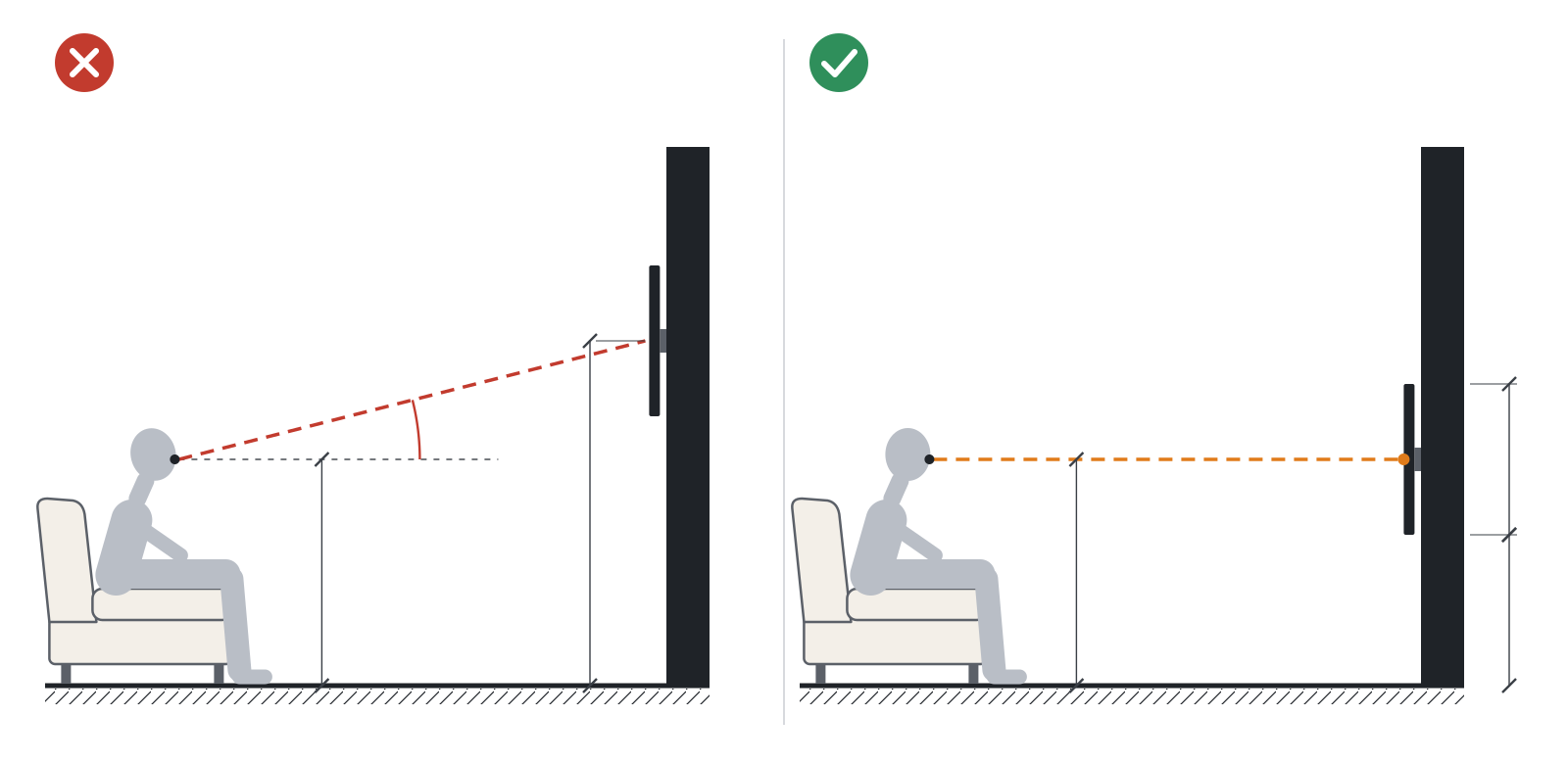
So a bigger screen does not go higher, its bottom edge comes lower. If the plan was to hang the big new one "a bit higher so it looks impressive", your neck has asked me to pass on its objection. Take the exact height of your own model from the box or the manual, because frames vary by a few centimetres from model to model.
If the TV is going on a unit instead of the wall
The sum is the same, with the TV's stand added in: take your eye height, subtract half the height of the screen and the height of the stand, and what is left is how high the top of the unit should be. With an eye height of 105 cm, a 55-inch TV and a 5 cm stand, the top of the unit should be no more than 65 cm from the floor. A lower unit is no problem at all, and the next section explains why.
If you have to be wrong, be wrong downwards
A few centimetres either way will hurt nobody. If you have to lean one way, though, lean low. Even the ergonomic guidance written for computer screens asks for the top of the screen at eye level or slightly below, because looking slightly down is easy on the neck and looking up is not.
What about above the fireplace?
The chimney breast is tempting, because it is already the wall everyone looks at. A screen above a mantelpiece ends up well above seated eye level, though, so my verdict is clear: if another wall works, use the other wall. If that wall is your only option, choose a bracket that tilts and angle the screen down towards the sofa. A fixed bracket up there gives the room the mood of a departure lounge, and you will catch yourself waiting for your gate number. 😂
How far should the sofa be from the TV?
Height is half the job and distance is the other half. Here too you get a clear multiplier: take the diagonal of the screen in centimetres (inches × 2.54) and multiply it by a number between 1.2 and 1.6. In that range the screen fills 30 to 40 degrees of your field of view. The 30 degrees is widely quoted as the SMPTE recommendation and the 40 degrees as THX's recommendation for a cinema feel.
55 inches (140 cm): between 1.7 m and 2.2 m
65 inches (165 cm): between 2.0 m and 2.6 m
75 inches (191 cm): between 2.3 m and 3.0 m
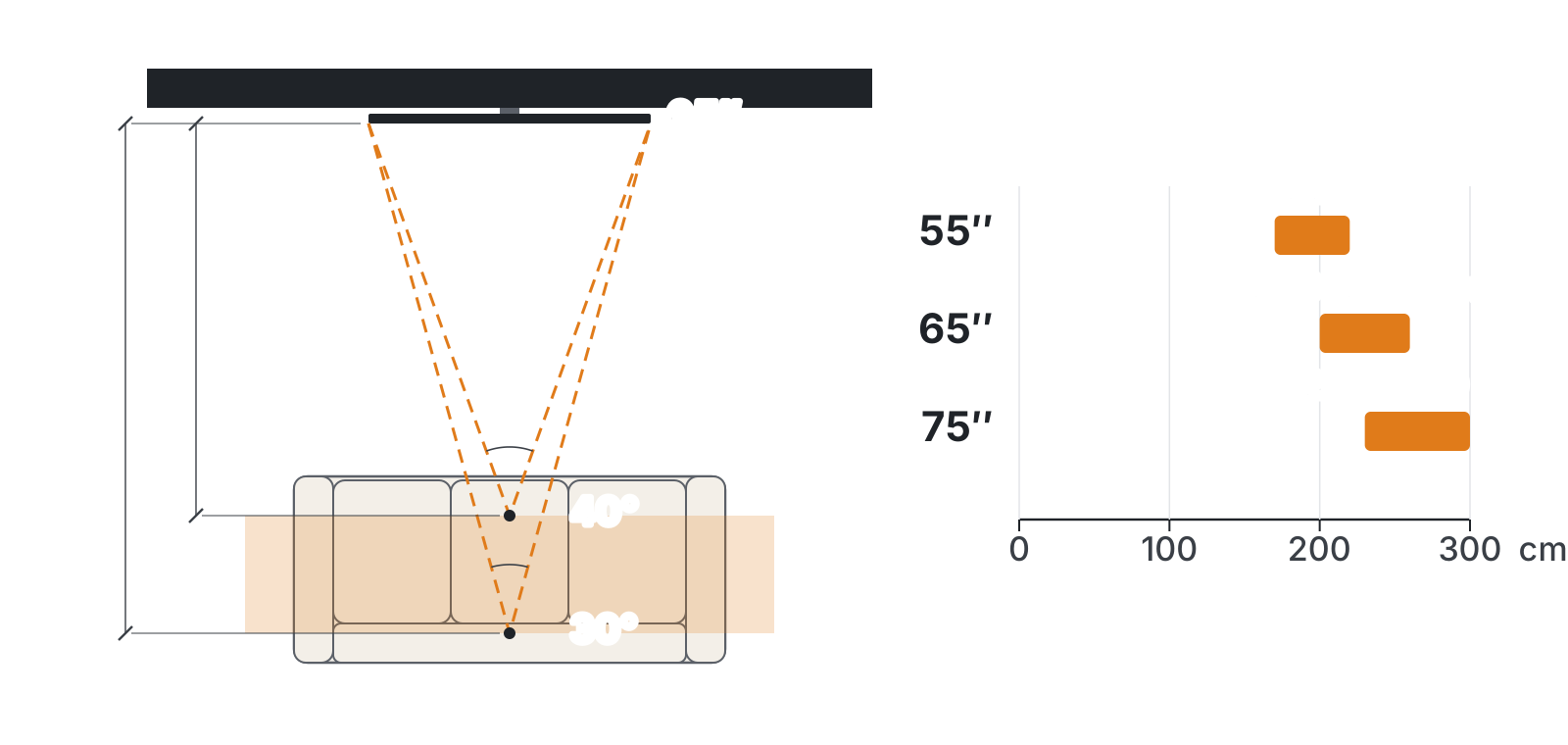
If your sofa is further back than that, nothing terrible happens, the picture simply feels smaller than it is. The limit to respect is the near one: sit closer than 1.2 times the diagonal and a film starts to feel like watching tennis from the umpire's chair.
The order matters too: decide where the sofa goes and measure the distance first, and only then choose the screen size. The giant screen bought because "it will fit on that wall" does not fit a 2-metre viewing distance.
Does the rule change in the bedroom or the kitchen?
The rule stays the same, your eye level moves. Propped up in bed, your gaze travels higher. That is why a bedroom TV hangs higher than the one in the living room, and why a tilting bracket is close to essential there. The method is the same: lie the way you lie when you watch, mark the spot on the wall where your eyes land, and put the centre of the screen there.
If you mostly watch the kitchen TV standing up, measure your standing eye height instead.
Three last checks before you drill
Hold a cardboard rehearsal: cut a piece of cardboard to the size of the TV, fix it to the wall with masking tape and spend an evening looking at it. It looks silly, and it is still far less silly than four extra holes in the wall. :)
Look at the window: avoid putting the screen in front of a large window, and check in daylight how the light reflects off it.
Think about sockets and cables: a socket planned behind the screen keeps the cables out of sight. If you are renovating, ask your electrician for that socket before the electrical work begins.
The measurements are done. Which wall, though?
This post has given you the height and the distance. In most living rooms the real sticking point comes one step earlier: which wall takes the TV, which way the sofa faces, and how the window, the door and the radiator change the answer. No single number solves that, because the answer depends on the plan of your room.
If that is exactly where you are stuck, in an online interior design session we settle the layout together from your measurements and photos, and afterwards a to-scale layout plan of your room arrives by email. That way the drill only has to come out once. :)
The four things to remember
The centre of the screen goes at your seated eye height.
The bottom edge is your eye height minus half the height of the screen.
When in doubt, go lower, and if the TV has to go high, use a tilting bracket.
Sit at least 1.2 times the screen diagonal away, and no more than 1.6 times if you want the cinema feel.
Now fetch the tape measure and sit down on the sofa. And if your television is currently looking down on you from above, you may politely tell it: "Come down here, we need to talk." :)


Comments